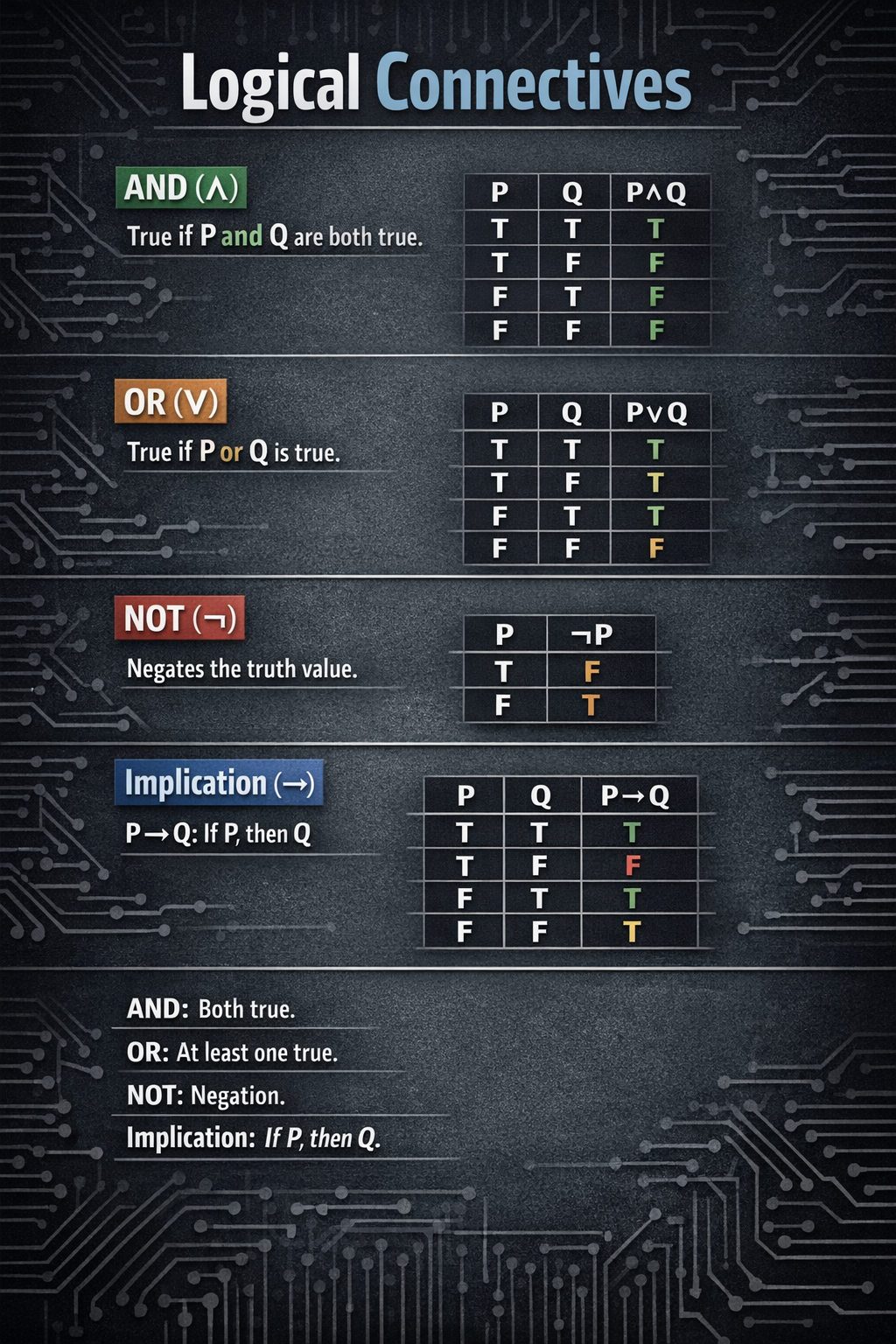
Logical connectives are the fundamental operators of formal reasoning. They allow the construction of complex propositions from simple statements and form the backbone of logic, mathematics, and computer science. Understanding them is essential for precise thinking and problem-solving.
AND (∧)
AND is the conjunction operator. It combines two statements and produces true only if both statements are true. Symbolically:
P ∧ Q is true if P = true and Q = true.
Otherwise, it is false.
Truth table:
| P | Q | P ∧ Q |
|---|---|---|
| T | T | T |
| T | F | F |
| F | T | F |
| F | F | F |
AND enforces simultaneous truth. Any false component renders the whole conjunction false.
OR (∨)
OR is the disjunction operator. It is true if at least one of the statements is true. Symbolically:
P ∨ Q is true if P = true, Q = true, or both are true.
It is false only when both are false.
Truth table:
| P | Q | P ∨ Q |
|---|---|---|
| T | T | T |
| T | F | T |
| F | T | T |
| F | F | F |
This is inclusive OR. Exclusive OR (XOR) differs: true only when exactly one statement is true.
NOT (¬)
NOT is the negation operator. It inverts the truth value of a statement. Symbolically:
¬P is true if P = false.
¬P is false if P = true.
Truth table:
| P | ¬P |
|---|---|
| T | F |
| F | T |
Negation allows expressing opposition, denial, or logical complement.
Implication (→)
Implication, or conditional, connects two statements such that P → Q means “if P then Q.”
It is false only when P is true and Q is false; otherwise, it is true.
Truth table:
| P | Q | P → Q |
|---|---|---|
| T | T | T |
| T | F | F |
| F | T | T |
| F | F | T |
Implication formalizes causality and rule-based reasoning. A false premise does not invalidate the statement; it only constrains truth when the premise is true.
Summary
- AND (∧): true only if all components are true.
- OR (∨): true if at least one component is true.
- NOT (¬): inverts truth value.
- Implication (→): false only when the premise is true and the conclusion false.
These connectives allow constructing complex logical expressions, performing proofs, and building computational logic structures. Mastery of them enables precise control over reasoning, eliminating ambiguity.