Introduction
In logic and mathematics, the concept of a statement—also called a proposition—is fundamental. Every proof, algorithm, and formal argument is built from statements that can be evaluated as true or false. Understanding statements, truth values, and symbolic representation using variables such as p and q forms the foundation of propositional logic and discrete mathematics.
What Is a Statement in Logic?
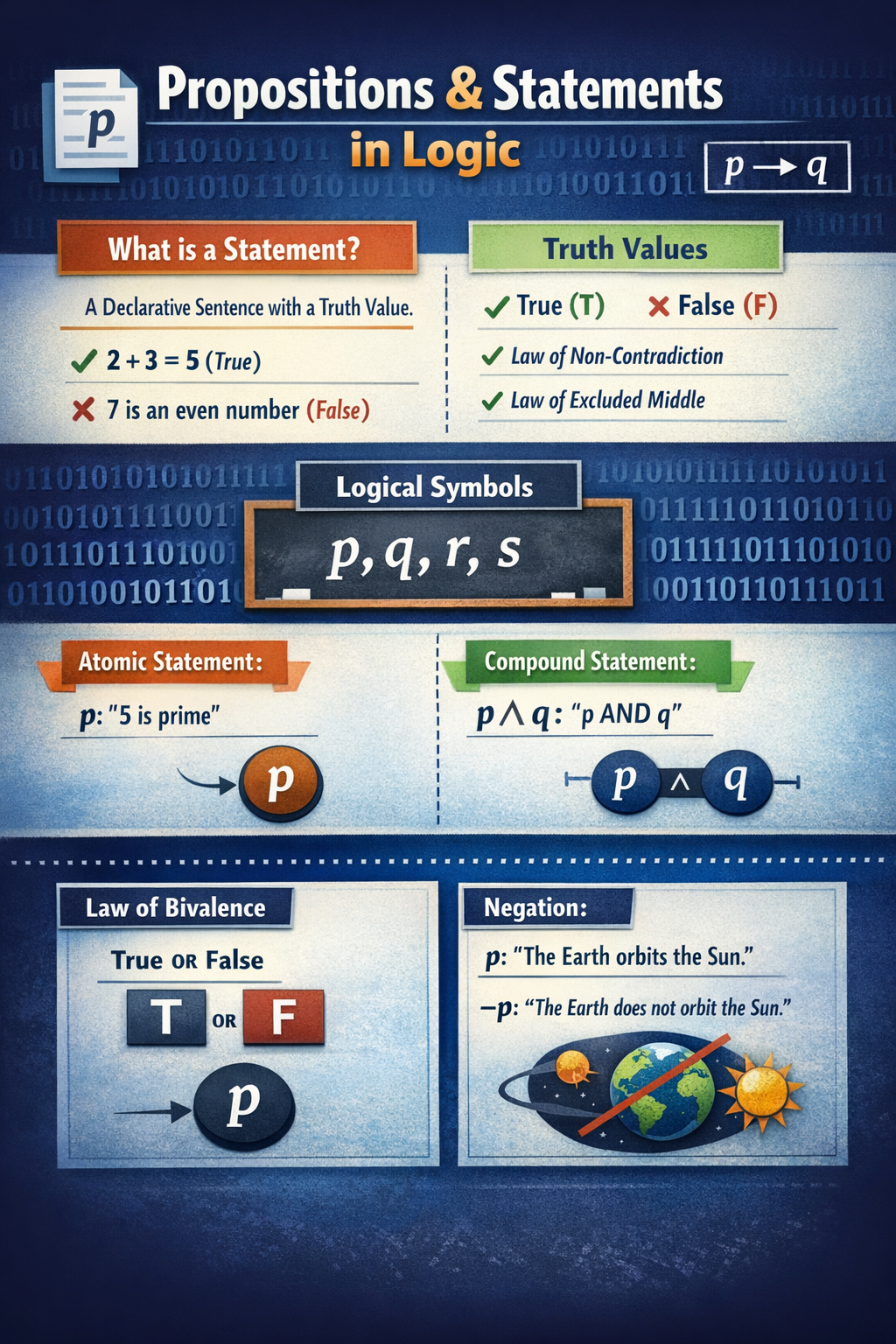
A statement (proposition) is a declarative sentence that has a definite truth value.
A sentence qualifies as a statement if:
- It is declarative.
- It is unambiguous.
- It is either true or false.
- It cannot be both true and false at the same time.
- It must have a clearly determined truth value.
Examples of Statements
- “2 + 3 = 5” → True
- “7 is an even number” → False
- “The Earth orbits the Sun” → True
Each example can be evaluated objectively. That evaluability defines a proposition.
What Is Not a Statement?
Not every sentence is a logical statement.
The following are not propositions:
- Questions: “Is 5 prime?”
- Commands: “Close the window.”
- Exclamations: “What a beautiful day!”
- Open sentences with variables: “x + 2 = 5”
An open sentence becomes a statement only after assigning a value:
If x = 3 → “3 + 2 = 5” → True
If x = 1 → “1 + 2 = 5” → False
A statement requires completeness and a fixed truth condition.
Truth and Falsity in Propositional Logic
In classical propositional logic, every statement has one of two truth values:
- True (T)
- False (F)
This principle is called the Law of Bivalence.
Two essential logical laws govern statements:
1. Law of Non-Contradiction
A statement cannot be both true and false at the same time.
2. Law of Excluded Middle
A statement is either true or its negation is true.
Example:
Let
p: “The Earth orbits the Sun.”
If p is true, then ¬p (“The Earth does not orbit the Sun”) is false.
Negation reverses truth value.
Logical Symbols: p, q, r
To analyze reasoning formally, logic replaces sentences with symbols.
Common propositional symbols:
- p
- q
- r
- s
Example:
p: “It is raining.”
q: “The ground is wet.”
Symbolic logic removes linguistic complexity and isolates logical structure. The content becomes irrelevant. Only the form matters.
This abstraction is essential in:
- Mathematics
- Computer science
- Boolean algebra
- Digital circuit design
- Artificial intelligence
- Formal proof systems
Binary truth values directly correspond to binary computation (1 and 0).
Atomic and Compound Statements
Atomic Statement
A single proposition that cannot be broken into simpler statements.
Example:
p: “5 is a prime number.”
Compound Statement
A statement formed by combining propositions using logical connectives.
Main logical connectives:
- Negation (¬p) — NOT
- Conjunction (p ∧ q) — AND
- Disjunction (p ∨ q) — OR
- Implication (p → q) — IF…THEN
- Biconditional (p ↔ q) — IF AND ONLY IF
Example:
p: “It is raining.”
q: “It is cold.”
Compound statement:
p ∧ q
“It is raining and it is cold.”
Truth depends on the logical relationship between components.
Why Understanding Statements Matters
Statements are the smallest units of logical reasoning. Every mathematical proof is a structured sequence of propositions connected by inference rules.
Without clear statements:
- Arguments collapse into ambiguity.
- Proofs lose validity.
- Computation loses precision.
Mastery of propositions and symbolic logic builds the foundation for:
- Discrete mathematics
- Formal verification
- Programming logic
- Algorithm design
- Theoretical computer science
Logical clarity begins with understanding what a statement is and how truth is assigned.
Statements are the atoms of logic.
Logic is the grammar of reasoning.
Reasoning structures mathematics.
Mathematics structures science.
Everything begins with a statement.